

Most days I take Precious out for a walk. 30 minutes, sometimes an hour. I always have something on - a podcast, a YouTube video, a newsletter read aloud …anything to do with AI and what’s happening in the world.
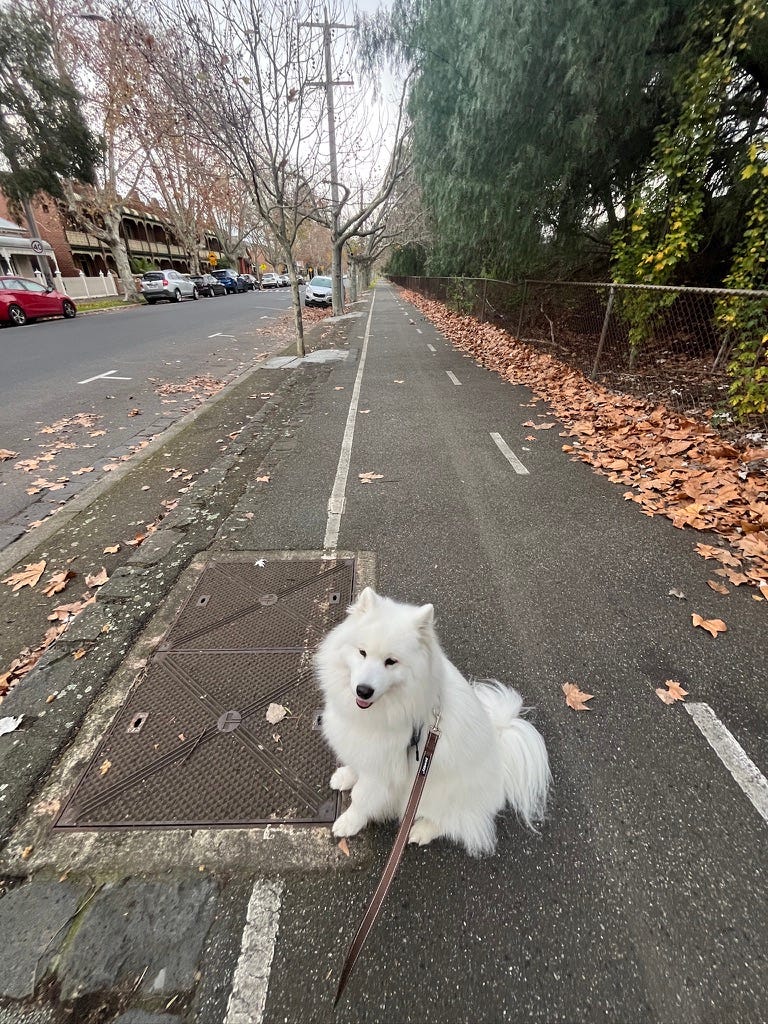
It’s become how I keep up. Walking and listening.
This week I was listening to Greg Isenberg talk through the Fable ban and halfway through the walk, I had a thought.
Not because of the news itself. I’d seen the headlines.
What stopped me was the detail: the US government gave Anthropic roughly 90 minutes to comply. And they pulled it. For everyone. Worldwide. No warning, no transition period, no “we’ll give you a week.”
90 minutes.
I’ve never actually gotten to use Claude Fable 5 - the model they pulled. It launched on 9 June and was gone by 12 June. The ban didn’t affect me directly.
But walking home that morning, I couldn’t stop thinking about the thing it revealed.
Here’s what actually happened
Two models. Simple version: Fable 5 was the powerful public version most people could access. Mythos 5 was the raw, unrestricted version …kept behind closed doors for approved partners only.
On 10 June, someone found a way to jailbreak Fable 5. The technique reportedly worked like money laundering: break a request into innocent-looking fragments until the model can’t tell what it’s actually being asked. Anthropic was asked to pull it voluntarily. They refused.
Then the government sent a letter.
At 5:21pm Eastern time on 12 June, the US Commerce Department issued an export-control order: no foreign national could access either model. Anthropic couldn’t verify nationalities in real time - so they switched both off for everyone.
On 27 June - 15 days later - Anthropic posted on X: “Since June 12, we’ve been working closely with the US government to restore access to Claude Mythos 5 and Fable 5. Today, the government notified us that Mythos 5, our strongest cybersecurity model, can be redeployed to a set of US organisations that operate and defend critical infrastructure.”
Mythos 5 is back - but only for about 100 approved organisations. Regular subscribers and developers: still nothing.

As of this writing, Fable 5 is expected back imminently. Anthropic’s International Managing Director said at a press conference in Seoul: “We are very confident that in the coming days, the models will become available again.” Pentagon and NSA sign-off is still outstanding, but most other agencies have already cleared it.
So it’s coming back. It took 16 days.
The thing it made me realise
I use Claude every single day. It’s in my writing, my thinking, my work. I’ve built workflows around it that I rely on.
And I’d never once thought about what I’d do if it just disappeared.
Not because the company failed. Not because I did anything wrong. Just because a directive arrived, and 90 minutes later, access was gone for everyone.
We’ve all been using these tools as if they’re permanent. As if they’re infrastructure …like water or electricity. But they’re not. Every one of them - ChatGPT, Claude, Gemini - is a service someone else controls that we just rent access to. And what can be switched on can be switched off.
Fable is coming back. But it took 16 days. For most people - 16 days without their main AI tool, no backup, no alternative.
That’s the single point of failure I’d never thought about.
What ‘local AI’ actually means
Local AI is straightforward: instead of connecting to a server somewhere to borrow someone else’s model, you download the model onto your own computer and run it there.
No internet required. No subscription. No order can revoke your access. Once you have it, it’s yours.
Two tools make this easy for non-developers:
LM Studio - install it like any other app. Browse available models, click download, start chatting. Takes about 20 minutes from nothing. No technical knowledge required.
Ollama - more powerful if you’re comfortable with a terminal.
The models worth knowing about:
GLM-5.2 is free to download. I'll be honest - I don't fully understand AI benchmarks, and I'm not going to pretend I do. But on the main test people use to compare models, GLM-5.2 scores 81 and Claude's best scores 85. Four points. I don't know exactly what that means technically. What I do know is that for most of what I actually use AI for day to day, I genuinely cannot tell the difference. And it costs roughly one-sixth the price.
DeepSeek V4 is another strong option. Open-source, priced at around $0.87 per million words of output - roughly 97% cheaper than the top Claude model.
There’s a concept called quantisation that makes this practical on a normal laptop. Think of it like video quality settings: 4K is perfect, 1080p looks great, 720p is totally watchable. Quantising a model shrinks it the same way. A model that once required a powerful machine now runs on a standard 16GB laptop. You lose a little at the very edges but for most everyday tasks, you genuinely can’t tell the difference.
Local models handle around 80% of everyday tasks. The remaining 20% …complex, multi-step reasoning still favours the cloud. So this isn’t about switching everything over. It’s about not being entirely dependent on something you don’t control.
The honest trade-offs
Setting up a local model takes about 20 minutes. Older laptops may run models slowly. And for genuinely difficult problems, the cloud is still smarter.
But: you own it. It works offline. It works on a plane. Nobody can switch it off in 90 minutes.
There’s a privacy upside too. When you run a model locally, your conversations stay on your machine - they don’t travel to a server. For anything sensitive, that matters.
What I’d actually suggest
This week, try one thing: download LM Studio, pick a model, and use it for one task you’d normally take to ChatGPT or Claude.
Not to replace anything. Just to have a backup.
The same way you save important files in two places. Or keep a spare charger in your bag.
he most powerful AI in the world was switched off in 90 minutes. It came back 16 days later. Almost nobody had a plan for those 16 days.
I didn’t either …until now.
One more thing. Most weeks there’s something from these walks that sticks - something I can’t stop thinking about on the way home. I’m thinking of making this a recurring thing: the walk, what I listened to, what it made me think. If that sounds like something you’d actually read, reply and let me know. It might become a series.
Cheers, Jagger
If this made you think, send it to someone who uses AI every day. They probably haven’t got a backup yet.